
Every request an analyst sends to a phishing page or criminal forum carries an IP address. If that address traces back to a corporate network or a security vendor, the operator can block it or swap the real page for a harmless decoy. Bulk collection also runs into rate limits and bot checks. A proxy layer hides the analyst’s network and spreads requests over addresses that can pass for ordinary traffic from the right country.
This review looks at Anonymous Proxies with those problems in mind. It explains the provider’s four main proxy types and maps them to OSINT, phishing analysis, ad fraud checks and geo-testing. Later sections cover what the service publishes about IP sourcing and acceptable use, followed by pricing and the main drawbacks.
At a glance
| Feature | Details |
|---|---|
| Provider | Anonymous Proxies |
| Operating since | 2010 |
| Main proxy types | Datacenter, ISP (static residential), rotating residential, SOCKS5 |
| Protocols | HTTP, HTTPS, SOCKS5 |
| Authentication | Username and password, or IP whitelisting |
| Targeting | Down to ZIP code (rotating residential) or subnet (datacenter) |
| Pricing model | Per IP (static and dedicated), per GB (rotating residential) |
| Trial | Free on rotating residential and SOCKS5 |
| Best for | OSINT, phishing analysis, ad fraud checks, geo-testing |
About Anonymous Proxies
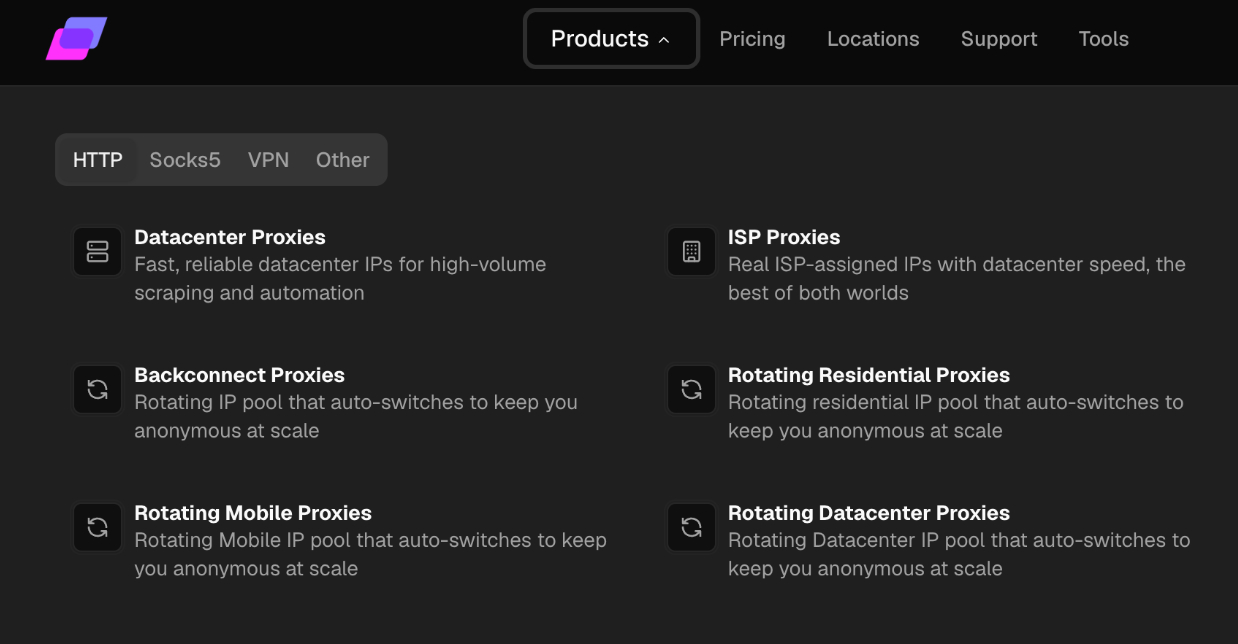
Anonymous Proxies (anonymous-proxies.net) has sold proxies since 2010 and claims more than 100,000 customers. Its core catalog has four types (datacenter, ISP, rotating residential and SOCKS5), plus rotating mobile, rotating datacenter and backconnect products. The range also covers Shadowsocks and Trojan protocols, WireGuard and Amnezia VPN, and a Smart DNS service.
The four main proxy types explained
Datacenter proxies
These proxies run on servers in data centers, so an ASN lookup on the exit IP names a hosting company. The provider sells them as dedicated IPs with instant activation, selectable by subnet, city, state or country across 100+ advertised locations. Many phishing kits and anti-bot systems block hosting ranges on sight. These IPs work better for threat feeds and APIs, where a fixed address is easy to whitelist.
ISP proxies
Also called static residential proxies, these use IPs issued by real internet service providers. Locations are limited to the US, UK, Germany, France, Spain, Canada, Sweden and Australia. Each address stays with the customer until they release it, and bandwidth is unlimited.
That stability suits long-lived research personas and logged-in accounts, where a changing address can trigger verification prompts. If a persona gets burned, its IP is burned too, since the address never rotates on its own.
Rotating residential proxies
Traffic exits through ordinary users’ devices, with a new IP per request or a sticky session that typically lasts 1 to 30 minutes. Coverage spans 195 countries, with large pools in the US (1.89M IPs), Spain (1.21M), the UK (1.20M), Germany (1.16M) and France (811K), and targeting goes down to ZIP code.
Since the exit IPs look like home connections, this type suits phishing and ad fraud checks. Concurrent connections have no per-session cap, but billing runs per GB, so media-heavy pages cost more.
SOCKS5 proxies
This type works below the application layer, so it carries traffic from non-HTTP tools such as SSH clients and custom scripts. The provider bases its SOCKS5 plans on dedicated datacenter or ISP IPs, exclusive to one account, with UDP support and unlimited bandwidth across 20+ locations.
The protocol, defined in RFC 1928, covers both TCP connections and UDP relay, which a client requests with the UDP ASSOCIATE command. It adds no encryption, so sensitive sessions belong inside TLS or SSH. Resolving hostnames at the proxy (socks5h in curl) keeps DNS lookups from leaking.
Security use cases
OSINT and threat intelligence collection
Broad collection from news sites and forums across regions calls for rotating residential IPs, since spreading requests over many addresses helps keep each one under rate limits. Research personas that log in repeatedly do better on ISP proxies, with one static IP per persona so a shared address cannot link the accounts.
Checking phishing and malicious pages from other countries
Phishing kits often show a blank or harmless page to visitors from hosting ranges or from outside the target countries. Rotating residential IPs in the targeted city or ZIP code get past that IP filter, and a sticky session holds one address through multi-step logins. The proxy hides only the analyst’s IP, so pages should still open in an isolated VM.
Ad fraud and brand protection checks
Malvertising chains and affiliate fraud schemes often hide their redirects from datacenter traffic, so checks need consumer IPs in the market under review. City-targeted residential IPs handle one-off sweeps, while unmetered ISP proxies suit recurring visits to the same counterfeit storefront. Work that touches Ticketmaster or Spotify cannot run through this service, since both sit on its restrictions list.
Testing geo-restricted apps and services
Engineers testing their own geo-blocking and country-specific fraud rules need traffic the app treats as local. ISP proxies give a stable residential address for repeat runs in the eight covered countries, and rotating residential fills in the rest. Datacenter IPs handle the reverse test, confirming that rules aimed at hosting ranges trigger as designed.
What to check before choosing a proxy provider
The first question is where residential exit IPs come from and whether the device owners agreed to carry other people’s traffic. Anonymous Proxies says these IPs are “sourced from real devices operated by ordinary internet users” and publishes nothing further about consent or partner networks.
Protocol support comes down to whether the service carries non-HTTP and UDP traffic. The provider supports HTTP and HTTPS plus SOCKS5 with UDP, and sells Shadowsocks, Trojan and VPN products for encrypted tunnels.
For authentication, buyers should confirm that access works by password as well as by source IP. Anonymous Proxies accepts both, so IP whitelisting can cover a fixed jump host and a password can cover cloud runners with changing addresses.
On abuse handling and acceptable use, the questions are which targets are banned and how misuse reports and customer data are handled. Anonymous Proxies publishes a restrictions list that bans targets such as Ticketmaster, sneaker sites, Bet365, Spotify and survey sites, plus tools such as Xrumer, GSA and Scrapebox. The site says nothing about abuse report handling, KYC requirements or logging practices.
Pricing and plans
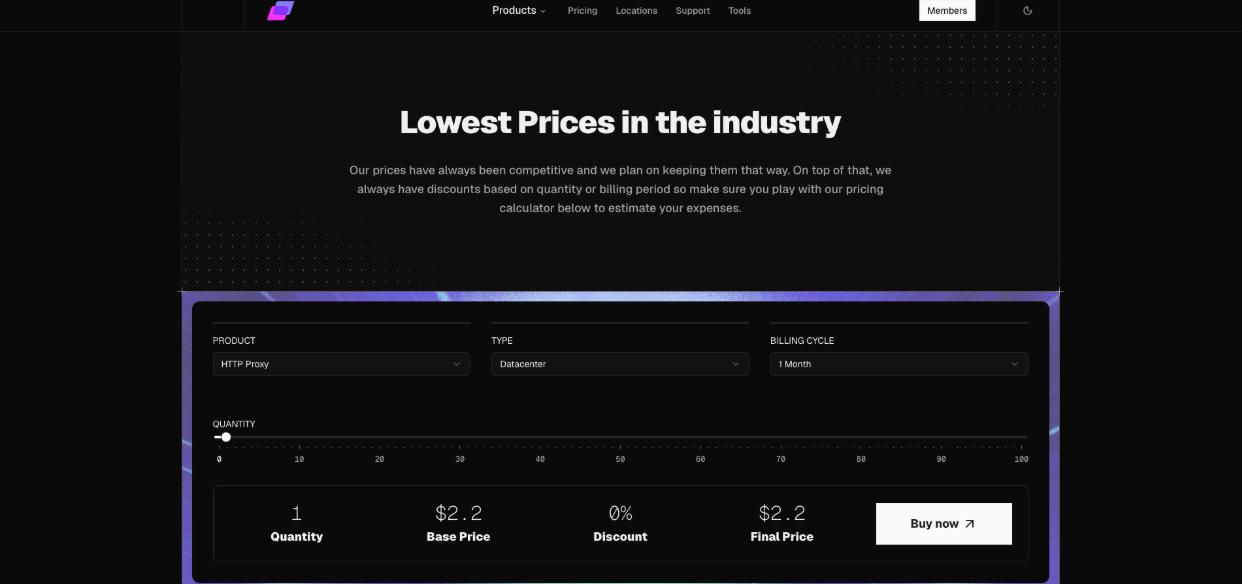
Static and dedicated proxies are priced per IP, with discounts for larger quantities and longer billing periods. Rotating residential is billed per GB, so blocking images and fonts in Puppeteer keeps collection costs down. A pricing calculator estimates the total for a chosen setup.
Refunds cover non-delivery or a service that fails to work as advertised, but not incompatibility with third-party software. Niche tools are therefore worth testing during the free trial on rotating residential or SOCKS5.
Pros and cons
| Pros | Cons |
|---|---|
| 16 years in business | Final price depends on configuration and is only clear in the calculator |
| Wide protocol range, including SOCKS5 with UDP | Limited public detail on residential IP sourcing |
| Granular targeting and per-IP selection by subnet | Narrow refund terms that exclude third-party software incompatibility |
| Two authentication options and a free trial | Some targets restricted, such as sneaker and survey sites |
Who Anonymous Proxies suits best
The service fits security teams that want one provider for several proxy types, from residential IPs for phishing checks to SOCKS5 for non-HTTP tools. Static ISP IPs also serve OSINT personas, and ZIP-level targeting helps with geo-testing.
Teams that must document IP consent or need published logging and KYC policies should look elsewhere unless the provider answers those points in writing. The same goes for work on targets that the restrictions list bans.